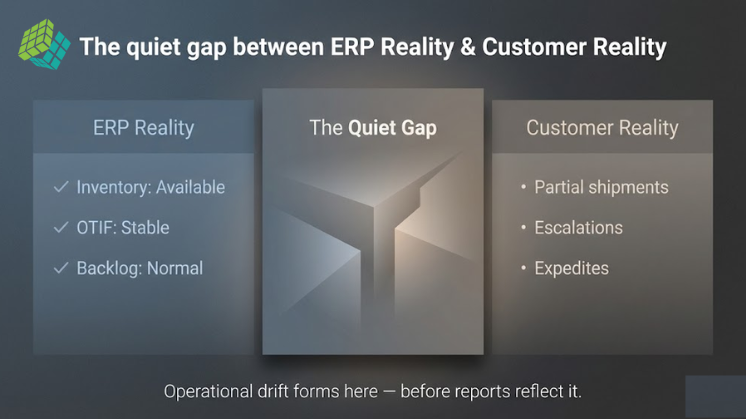
The quiet gap between ERP reality & Customer reality.
There is a cost most distribution businesses carry that never appears on the P&L.
- It hides in repeated expedites that feel justified.
- In manual reallocations that “save the order.”
- In split shipments that seem reasonable at the moment.
- In customer conversations that end with, “We’ll make it right.”
None of these decisions looks alarming on its own. In fact, many of them feel like good operations. But together, they form a shadow cost – one that accumulates quietly, long before KPIs acknowledge it.
ERP continues to reconcile. Dashboards stay green. Nothing has officially failed. Yet the business feels heavier.
More overrides. More follow-ups. More “just this once” conversations. Customers are restless. Teams are compensating. Leadership senses something drifting, without being able to point to a single red metric.
This is not a reporting failure. It is the growing gap between ERP reality and customer reality.
When systems look stable, but operations don’t feel that way:
Mid-market distribution operations rarely collapse dramatically. They normalize quietly.
- Inventory is “available.”
- Service levels are within tolerance.
- Dashboards stay green.
But on the ground:
- Certain SKUs are always rushed.
- Certain customers always need manual intervention.
- Certain lanes always feel fragile.
The system is technically correct. The experience is increasingly inconsistent. This is where most organizations misdiagnose the problem as visibility – adding more reports, more dashboards, and more KPI reviews.
Why traditional KPIs aren’t enough (and were never designed to be):
KPIs are not wrong. They are simply designed for a different job. In reality KPI do help with:
- Aggregate behavior into averages.
- Confirm outcomes after they’ve occurred.
- Prioritize governance and comparability
ERP Operational drift, however, forms elsewhere:
- In localized patterns, not aggregates.
- In repetition, not single events.
- In latency, not end-of-month outcomes.
A handful of SKUs slipping just before reorder triggers will break fill rate. Or a vendor whose delays stay just under SLA limits will not violate OTIF, until variability compounds.
Or a team expediting “just this once” will not move KPIs until recovery becomes routine. By the time KPIs demand attention, the business has already adapted to the problem.
Admit it, right KPIs for your business can answer “Are we okay?” But they do not answer “Where are we starting to bend?”
How does ERP Operational drift become normal?
The uncomfortable truth most business users recognize immediately:
- People compensate faster than systems escalate.
- Planners adjust. Warehouse leads override.
- Customer service absorbs friction.
- Tribal knowledge fills the operational execution gaps that the ERP logic cannot.
The operation survives. The dashboard still stays calm. Drift becomes normal. This is why organizations are often surprised by:
- Sudden escalation spikes.
- Margin erosion that feels “unexpected.”
- Customer dissatisfaction appears out of sync with service metrics.
The signals were always present. They just never crossed a formal threshold.
ERP State vs Customer Experience:
ERP is excellent at recording state: Inventory posted, Orders released, Shipments confirmed. But customers experience patterns:
- “My orders are always split.”
- “This item is always delayed.”
- “I never know if the promise will hold.”
ERP tells you what the system believes to be true at a given point in time. Customers react to how reliably you behave over time. The gap between those two realities is where trust erodes, long before KPIs collapse.
This Is Not Just a KPI Problem:
When you look closely, the gap usually forms across multiple dimensions:
- Lagging metrics that move after damage is done.
- Averages that hide clustered failures.
- Erp data integration cadence that is slower than operational change.
- Master data and policy drift are accumulating silently.
- Workarounds masking structural issues.
- Incentives optimizing local success at global cost
None of these is catastrophic alone. Together, they create a system that looks stable while becoming fragile.
The missing layer in most architectures:
Most organizations already operate with three layers, even if they don’t name them: Execution systems (ERP, WMS, TMS): what gets recorded; Performance systems (KPIs, dashboards): what gets measured; Human judgment: what prevents failure.
What’s missing is a layer that watches behavior before outcomes degrade. This is precisely where RubiCube sits.
RubiCube does not replace ERP. It does not compete with KPIs. It operates in the window before KPIs move, where ERP Operational drift is visible in patterns rather than failures.
RubiCube surfaces signals that traditional systems overlook:
- Repeated expedites by the same SKUs.
- Allocation overrides clustering by customer or region.
- Promise-to-pick lag widening quietly.
- Split shipments are becoming routine rather than exceptional.
- Vendor variability accumulating below SLA thresholds
Individually, these signals look harmless. Collectively, they predict where the business will feel pain next.
From Seeing Faster to Seeing Sooner:
Most analytics promise faster reaction.
RubiCube is designed for earlier recognition. By surfacing early-warning patterns (or early warning analytics), RubiCube reduces decision latency, not by speeding up execution, but by shortening the time between drift formation and intervention.
This allows teams to:
- Act while options still exist.
- Intervene before recovery becomes a habit.
- Protect the margin and trust before erosion becomes visible.
If your team is working harder just to keep metrics stable, drift has already begun. Overrides, expedites, and workarounds feel like good operations until they become routine. That’s when control quietly shifts from systems to people and recovery becomes the default mode.
RubiCube doesn’t tell you that something failed. It shows you where strain is accumulating before your team must absorb it. That means fewer surprises, fewer heroics, and fewer “we’ll fix it later” decisions.
Nothing must break for things to bend. The advantage is seeing it early enough to straighten it before the load becomes permanent. It’s about protecting resilience before stability turns into brittleness.