The Cost of Making Procurement Decisions with Stale Data
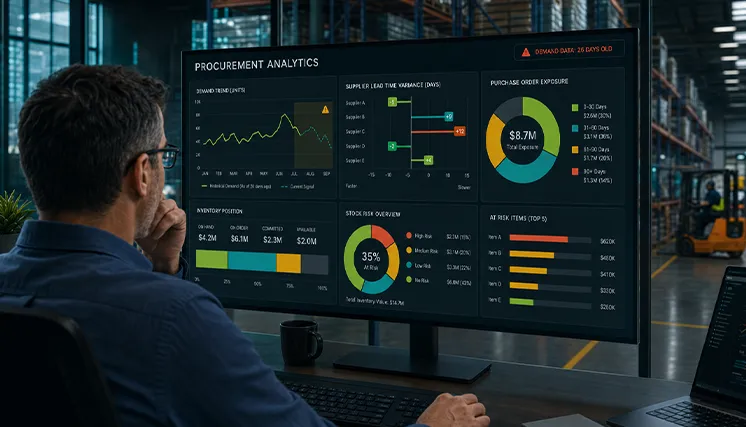
The data lag problem in procurement isn’t a secret.
Ask most experienced buyers whether the demand signals they’re working from are current, and they’ll tell you, honestly, that they’re probably two to four weeks behind reality. They know it. Their managers know it. It’s mentioned in team meetings and then set aside because the order still has to go out.
That’s not a data problem. That’s a confidence gap, and it’s one of the more quietly expensive dynamics in mid-market supply chain operations. What you lack is decision intelligence.
What actually happens inside the gap
When buyers know their data is unreliable but still have to make a call, they don’t freeze. They compensate.
They add a buffer. They over-order on fast-moving lines because the last time they trusted the system, they stocked out. They hold back on slower lines because the numbers looked promising before, and the stock sat for six months. They call the warehouse directly to verify before committing. They rely on supplier relationships to get informal signals that the system isn’t giving them.
None of this is irrational. It’s experienced people doing the best they can with the information available. But it adds up to a procurement process that, in practice, runs on instinct dressed up as data, and the financial consequences are baked into every order cycle.
Excess buffer stock ties up cash. Informal signals aren’t traceable or consistent. Individual buyer judgment, however experienced, doesn’t scale. And when something goes wrong, a supplier delay, a demand spike, a missed window, there’s no clean audit trail of what information the decision was based on or why.
Why doesn’t the gap get escalated?
Here’s the part that matters: most procurement teams absorb the data lag as a personal risk rather than escalating it as a systemic one.
There are a few reasons for this. First, it feels like a known condition: “we’ve always worked this way” is a powerful silencer. Second, raising it formally requires quantifying it, which is hard to do when the problem is precisely that you don’t have reliable data. Third, and most importantly, buyers are judged on outcomes. If the workarounds hold and the shelves stay stocked, the underlying fragility stays invisible.
So the lag gets managed quietly, order by order, through judgment calls that never get documented. The organisation never sees the aggregate risk. Leadership doesn’t realise their procurement confidence is built on individual expertise rather than system reliability until someone leaves, the buffers fail, or a disruption hits, and the response is slower than it should be.
A scenario that plays out more often than it should
A regional manufacturer runs monthly procurement reviews. The demand data used to feed those reviews is pulled from the ERP at the start of the review cycle, so by the time buying decisions are made, the data is already three weeks old.
In that three-week window, two large customer orders came in that weren’t in the system at the time of the pull. The buyers don’t know about them. They order based on the numbers. The orders ship. The new customer demand hits. The stock that should have covered it is already allocated elsewhere.
The result is an expedited order at a higher cost, a delayed delivery, and a customer conversation nobody wanted to have. The root cause, a three-week data lag, never makes it into the post-mortem. The outcome gets attributed to demand volatility. The system stays unchanged.
What closing the gap actually requires
Fresher data is necessary but not sufficient.
If you give buyers real-time demand signals but the process still requires them to act on a monthly review cycle, the lag just moves. The data is live, but the decision cadence isn’t.
Closing the confidence gap requires three things working together: data that is current enough to trust, a decision process fast enough to act on it, and visibility that makes the buyer’s reasoning traceable. This is so that when something goes wrong, the organization learns from the decision, not just the outcome.
The organizations that get this right don’t have better buyers. They have a system that encourages good decisions by making the right path the path of least resistance. Acting on accurate data is easier than creating workarounds for inaccurate data.
That’s the real infrastructure problem. And solving it starts with acknowledging that your procurement team’s confidence isn’t the asset you think it is; it’s a signal that the system hasn’t yet earned their trust.
Key takeaways for procurement intelligence
- Most buyers already know their data is stale. The problem isn’t awareness; it’s that the process gives them no alternative but to act anyway.
- Data lag gets absorbed as individual risk, managed through buffers and informal signals that don’t scale and can’t be audited.
- It rarely gets escalated because it’s a known condition, hard to quantify, and invisible when the workarounds hold.
- Fresher data alone doesn’t close the gap; the decision cadence and traceability have to change alongside it.
- If your procurement confidence is resting on buyer experience rather than system reliability, the risk is real, and it’s already compounding.
Let’s solve the procurement confidence gap. Understand buyer decision-making with RubiCube, a top procurement intelligence platform.