Just-in-Time Is Breaking: What the Hormuz Crisis Means for Manufacturers
There’s a phrase that used to get nodded at in operations meetings without much argument.
“We run just in time.”
It signalled efficiency, discipline, no waste. Your suppliers delivered what you needed, when you needed it, and you kept the shelves lean and the capital free. For a long time, that was the smart way to run things. Then the world stopped cooperating.
The Strait of Hormuz changes everything
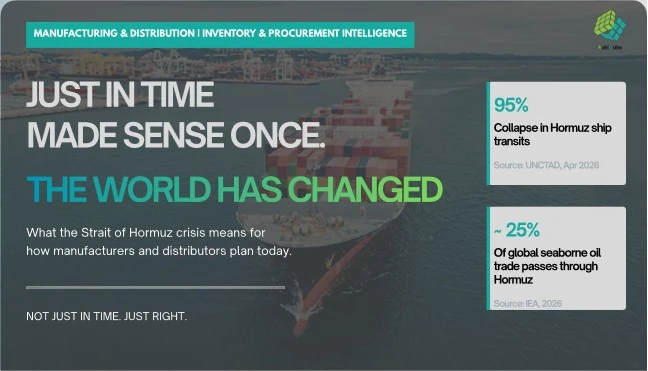
Ship transits through the Strait collapsed from around 130 per day in February 2026 to just 6 in March. That’s a 95% reduction in traffic through a waterway that carries roughly a quarter of the world’s seaborne oil trade and significant volumes of LNG, fertilizers, and industrial chemicals.
Unlike the Red Sea disruptions of recent years, where vessels could reroute around Africa’s Cape of Good Hope, the Strait of Hormuz has no viable maritime alternative.
Hormuz crisis supply chain impact – The consequences are spreading fast. Energy costs are rising. Freight rates and insurance premiums are climbing together. The disruption extends well beyond oil fertilizers, methanol, sulphur, and industrial chemicals are all affected. For manufacturers that depend on any of these inputs, the supply assumptions underpinning their purchasing plans are being stress-tested in real time.
This isn’t the first test. But it might be the most concentrated.
COVID-19 showed how a global shock could freeze supply chains simultaneously. Tariff shifts over the past few years have forced businesses to reconsider sourcing relationships that took years to build.
But Hormuz is different in character. It’s a single physical chokepoint with no workaround. Businesses that had rerouted away from the Red Sea now have nowhere left to reroute. The contingency plan has run out of contingencies.
The question for manufacturers and distributors isn’t just “when will this resolve?” It’s: was your planning approach ever built to absorb a disruption like this?
What happened when JIT assumptions broke
When supply chain assumptions first cracked a few years back, most businesses did the understandable thing. They swung the other way.
Hold more. Order earlier. Build the buffer up and keep it there.
For a while, that felt like the right lesson. Then the warehouses filled up. Working capital disappeared into stock that wasn’t moving. Goods edged toward their expiry dates. The write-offs started showing up in the monthly numbers.
So now there are two failure modes on the table. Run too lean and a disruption like Hormuz takes you down fast. Hold too much and you slowly bleed cash, space and margin. Neither is a strategy. They’re both reactions – to different fears, at different moments.
The businesses getting this right aren’t doing anything exotic
They’re just working from better information.
Not blanket policies. Not gut feel. They know – at product level, by supplier, by lane – where the actual exposure sits. A few things that show up consistently:
- They’re forecasting from what’s happening now, not last year.Demand patterns have shifted. Input costs are moving. The forecast needs to weigh current signals and update when things change – not assume that recent history extends in a straight line.
- They know what their safety stock number actually is – and why. The right buffer for any product is a function of demand variability and supply reliability. Run those numbers and you get a figure you can defend. Most businesses are still guessing, or applying a blanket rule that hasn’t been revisited in years.Inventory management became more important than ever.
- Their lead time assumptions are current. Lead times have changed – for some businesses dramatically – and the planning models haven’t always caught up. Old assumptions sitting in purchasing systems are a quiet risk that doesn’t announce itself until something goes wrong.
- They know which SKUs are actually exposed. Not every product in your range is equally vulnerable to a Hormuz disruption. Some inputs come entirely from affected regions. Others don’t. Businesses that know the difference can protect the lines that matter and manage the rest differently. What the business actually needs is inventory and procurement intelligence.
A planning problem, not just a procurement one
The instinct under supply chain pressure is to treat it as a procurement challenge. Find more suppliers. Move faster. Negotiate harder.
Most manufacturers and distributors don’t have a clear, current, product-level view of where their supply risk actually sits. They don’t have demand forecasts they trust. They don’t have safety stock levels tied to real data. Without that visibility, every procurement decision is a judgment call made with incomplete information. With it, you can make those decisions with confidence, even when the world is closing off its shipping lanes one by one.
JIT isn’t dead. But it needs a foundation it never had: real intelligence about what demand is doing, what supply is doing, and where the two don’t match.
Not just in time. Just right.
How RubiCube helps?
RubiCube gives manufacturers and distributors the demand and supply chain intelligence platform to plan with confidence. Demand forecasting built on current signals. Safety stock calculations at SKU level. Supplier lead time tracking that feeds directly into purchasing decisions.
The visibility to know where your real exposure sits – and act on it before it becomes a crisis.