If You Have 100 KPIs and Only Use 10 to Make Decisions, Which 90 Are Wasting Your Time?
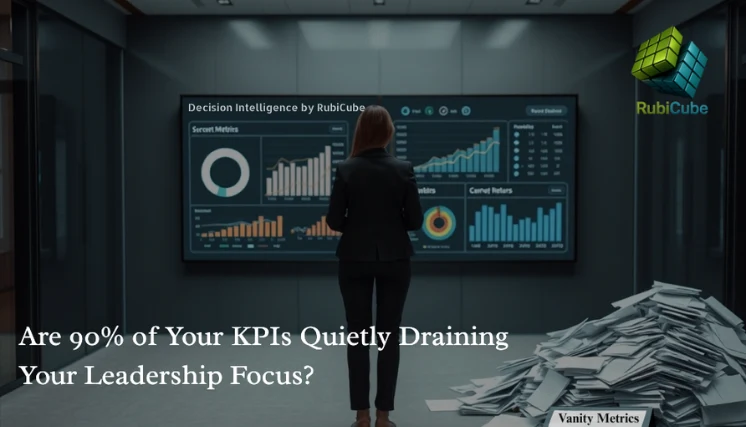
Leadership teams love their KPIs. In boardrooms worldwide, performance dashboards flicker on giant screens, a rainbow of bar charts, trend lines, pie slices, and traffic lights. The more you scroll, the more there is to see.
Yet here’s the uncomfortable truth: Most leadership teams make strategic decisions based on less than 10 metrics.
“That means 90% of what you’re tracking is either background noise or an expensive distraction.”
What is KPI Overload and Why Does It Hurt Leadership Decisions?
For most leadership teams, the Monday morning ritual is the same:
A conference room or Zoom call. A giant screen is lighting up with dashboards. Dozens of charts. Color-coded KPIs. Metrics are neatly aligned in rows and columns.
And then, the mental triage begins.
“Which numbers matter right now? Which ones can wait? Which ones are just noise?”
The truth? It’s rarely a quick process. Leaders spend the first 15–20 minutes just orienting themselves, scrolling through charts, scanning trends, and mentally stitching together a story from disconnected data points.
By the time the group decides, the meeting has already burned through time, focus, and energy.
Tracking KPIs isn’t free. Every metric comes with hidden costs:
- Data gathering costs – integrating multiple systems, building ETL pipelines, handling exceptions, and manually cleaning data when automation fails.
- Processing overhead – servers, storage, and analytics platforms crunching numbers that may never influence a single decision.
- People time – analysts compiling reports, managers interpreting trends, and leadership teams holding follow-up meetings to debate what those trends “might” mean.
If your organization tracks 100 KPIs but only 10 truly drive decisions, you’re not just over-measuring, you’re slowing decision velocity, diluting focus, and bleeding resources.
One global retail CFO who was obsessed with his restaurant analytics, summed it up perfectly over coffee: “We have more dashboards than people who can act on them.”
This isn’t just inefficiency. It’s dashboard fatigue, the silent productivity killer. The more metrics you track, the harder it becomes to see the signals through the noise.
When every chart looks important, leadership risks making decisions based on incomplete context, gut feel, or consensus fatigue. And in today’s market, delayed or diluted decisions are often more costly than outright mistakes.
Why Have BI Dashboards Become Fatigue Machines?
Business Intelligence tools promised clarity. But somewhere along the way, “being data-driven” became “collecting every possible data point just in case.”
The result?
- Information obesity – too much to consume, too little nourishing.
- Decision paralysis – endless debating instead of decisive action.
- KPI inflation – once you start tracking something, it rarely gets removed, even if its relevance fades.
You open your dashboard, hoping for answers… but instead you get a visual encyclopaedia of your business. It’s impressive to look at, but exhausting to navigate.
Here’s the irony: The problem isn’t a lack of data. It’s a lack of focus.
What if Your Analytics Showed You Only What Mattered?
This is precisely where RubiCube takes an entirely different stance.
Instead of overwhelming you with everything you could track, RubiCube identifies and surfaces only the metrics that move the needle for your business.
We call this Decision Intelligence: the art and science of turning raw data into a focused, decision-ready view.
It’s not about having more KPIs. It’s about knowing which ones deserve your attention today.
The RubiCube Difference
Unlike generic BI dashboards, RubiCube doesn’t assume that two businesses in the same industry should examine the same metrics.
“Two restaurants. Same city. Same customer demographic. Different growth levers.”
“Which KPIs should I prioritize as a hospitality chain?”
In a typical BI setup, with traditional restaurant analytics, they’d see nearly identical dashboards. In RubiCube, they’d see completely different decision views because their paths to growth are unique.
Example 1: Multi-Location Hospitality Chain
A hotel group came to RubiCube with over 40 tracked KPIs as part of their restaurant analytics, ranging from average daily rate to loyalty program churn to breakfast buffet feedback scores. That’s the traditional way of tracking analytics using any analytics platform for restaurants.
After analysis, RubiCube identified seven key decision metrics that drive revenue growth.
Surprisingly, one of the top levers wasn’t a financial metric at all, it was guest review sentiment around staff responsiveness during check-in.
Why? Because delayed check-ins were causing negative reviews, they were affecting booking rates on OTA platforms.
By focusing on this operational metric and making small process changes, the chainsaw:
- A 22% uplift in OTA bookings within 3 months.
- An increase in repeat bookings without additional marketing spend.
Example 2: Chain of Themed Restaurants
This group thought their success hinged on menu engineering for restaurants and seasonal promotions. That’s what their previous BI dashboards reinforced.
However, RubiCube’s Decision Intelligence layer discovered that the real driver of per-visit spending wasn’t the menu but the average dwell time per table. That’s Real-time restaurant analytics.
The insight? Themed dining experiences were more profitable when guests stayed longer, leading to higher add-on orders like desserts and premium drinks.
With this focus, the chain:
- Adjusted service flow to extend dwell time without compromising table turnover targets.
- Introduced in-dining entertainment to keep guests engaged.
Result: 17% higher per-visit spend and a measurable increase in customer satisfaction scores.
This Is the Crux of Decision Intelligence
The world doesn’t need another dashboard with 100+ KPIs. It requires tools that understand your unique business mechanics and cut through the noise to show the 5–10 metrics that shape your outcomes. Those are the right KPIs for your business.
That’s what RubiCube is built for.
We don’t create “templated dashboards for your industry.” Instead, we build custom decision lenses that adapt to your business, market, and goals.
How Can Decision Intelligence Reduce Dashboard Fatigue?
1. Resource Reallocation:
Stop wasting analyst hours maintaining irrelevant KPIs. Redirect that effort toward insights that directly support decision-making.
2. Faster Time to Insight:
The fewer distractions there are, the quicker you see what needs action. This is a competitive edge in markets where speed wins.
3. Better Strategic Alignment:
When everyone’s looking at the same critical metrics, alignment across teams improves naturally.
A Leadership Reflection: How many KPIs is too many for effective leadership?
If you’re in the C-suite or on the leadership team, ask yourself:
- Which KPIs shaped a decision in the last 90 days?
- Which ones were “nice to know” but had no strategic impact?
- How many hours were spent updating or debating the latter?
The answers might be uncomfortable, but they’re the first step toward reclaiming your focus.
Because in the end, business growth isn’t about tracking more. It’s about deciding faster, with clarity, on what truly matters.
If you’re facing confusion, stuck in KPI overload, or struggling to understand what really moves the needle, we’re here to help.
RubiCube helps leadership teams cut through the noise, surface the metrics that drive outcomes, and turn data into confident decisions.