Distribution leaders don’t manage inventory; they manage recovery capacity.
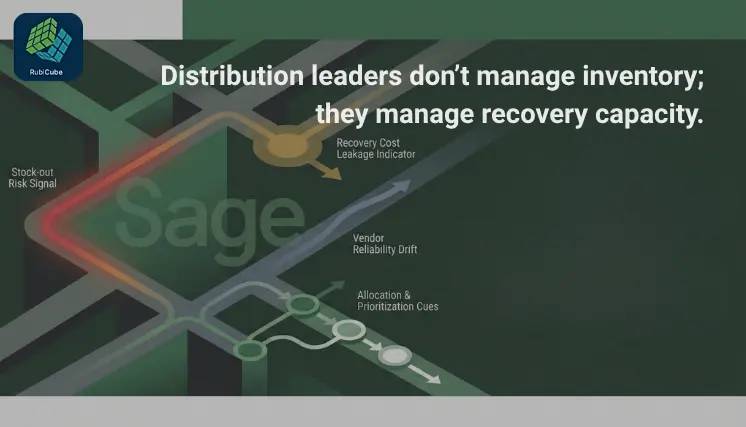
In most distribution and wholesale organizations, inventory management appears to be the central discipline. Stock levels are reviewed, replenishment rules are tuned, service levels are tracked, and dashboards are monitored with discipline.
“From a distance, the system looks controlled. From the inside, the leadership effort tells a different story.”
Much of a distribution leader’s time is not spent optimizing flow. It is spent approving expedites, resolving shortages, reallocating limited stock, negotiating substitutions, and absorbing exceptions that were never part of the original plan.
These actions are rarely labelled as failures. They are treated as “what it takes to keep the business running.”
When recovery becomes the operating model:
Recovery is not inherently bad. Every distribution business needs the ability to respond when demand spikes, suppliers slip, or logistics fail. This, in short, is called Distribution Decision Intelligence.
The problem arises when recovery shifts from an exception to the default mode of operation. Expedites become routine. Split shipments become expected.
Manual overrides become normal.
Leadership calendars fill with allocation calls instead of flow reviews.
At this point, the organization is no longer primarily managing inventory. It is managing the consequences of late decisions.
One of the most difficult aspects of this shift is that it rarely announces itself clearly.
Key metrics may still be within tolerance. Inventory availability may look acceptable in the system.
Financial performance may not yet show visible deterioration. This is not because the ERP is failing.
Modern ERP platforms such as Sage do exactly what they are designed to do. They provide reliable execution, transactional accuracy, and trusted visibility into stock, orders, suppliers, and financials.
What they are not designed to do is reason about emerging patterns of strain.
The hidden cost of recovery:
The true cost of recovery is rarely visible as a single line item. It is spread across freight premiums, overtime, lost productivity, margin erosion, customer concessions, and opportunity costs. Because it is fragmented, it is often underestimated.
Every hour spent resolving exceptions is an hour not spent designing more resilient flow, strengthening supplier strategy, or improving allocation logic. Over time, leadership focus becomes reactive by necessity, not choice. This is how strong distribution businesses quietly lose operating leverage.
Seasoned distribution leaders often feel this shift long before numbers change. They notice the same SKUs repeatedly appearing in exception lists. They see certain suppliers requiring increasing follow-ups to meet commitments. They recognize that warehouse teams are “pre-solving” problems before orders are even released.
Most mid-sized distributors are not short on data. They have access to stock positions, lead times, order backlogs, and service metrics. What they lack is prioritization when it matters.
Leadership decisions are rarely about whether data exists. They are concerned about whether a signal warrants intervention now or can wait until the next cycle safely. They are about consequence, not measurement.
Traditional analytics excels at explanation. It tells us what happened and how the performance trended. But recovery begins forming before performance visibly degrades.
This is the gap that many distribution organizations now face.
The role of RubiCube, a Distribution Decision Intelligence:
Decision Intelligence is not another reporting layer. It is a different category of capability.
- Instead of summarizing outcomes, it focuses on patterns across cycles.
- Instead of highlighting all exceptions, it prioritizes the few that matter most.
- Instead of waiting for KPIs to change, it surfaces early drift that predicts recovery.
RubiCube is built specifically to operate at this decision layer. It sits above ERP execution and analytics visibility, using trusted Sage data as its foundation.
The role of distribution decision intelligence is to help leaders see where recovery is forming early enough to prevent it from becoming routine, as part of ERP data integration.
In practical terms, this means identifying:
- Which SKUs generate disproportionate expedite cost over time?
- Which suppliers show rising lead-time variance before service levels fall?
- Which locations or flows repeatedly create phantom availability?
- Which “temporary” workarounds have become structural risks?
For distribution leaders, this means fewer surprises, clearer prioritization, and reduced dependence on heroic recovery. Across the distribution and wholesale landscape, this shift is quietly happening.
Leaders are no longer asking only, “Do we have enough stock?” They are asking, “Where is strain building, and what happens if we wait one more cycle?” That’s decision intelligence.
For the leadership team, distribution recovery management always exists. But when recovery becomes the primary job, margin, focus, and confidence suffer.
The next phase of operational excellence in distribution is not about seeing more.
It is about deciding sooner.
RubiCube works with distribution leaders and inventory management functions to surface early operational drift and support better decisions on top of trusted Sage ERP