From Stockouts to Overstocking: Solving Restaurant Inventory Problems
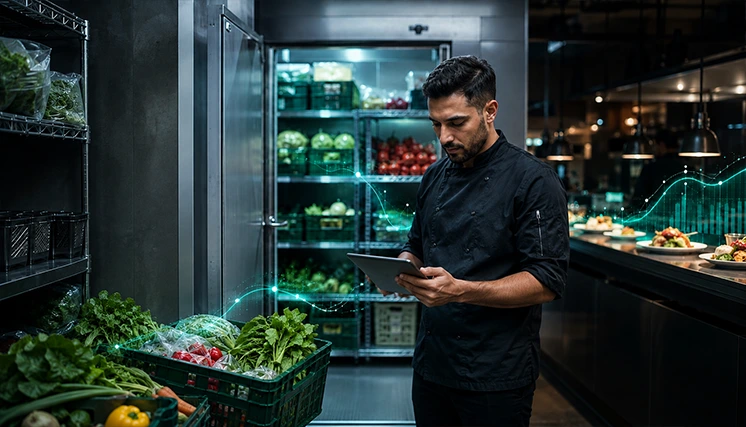
A restaurant can have a busy Saturday night, a nearly empty Monday, and a special festival coming up, all in the same week. Yet the kitchen still needs to decide how much to buy, what to prepare, and what to keep in stock.
That is where restaurant inventory problems get difficult. Too little stock can mean a dish is unavailable when customers want it. Too much stock can mean spoilage, waste, tied-up working capital, and ingredients sitting unused in the kitchen.
Let’s take a simple example: a restaurant sells a popular chocolate cake. On a normal weekday, demand is predictable. But what happens when an auspicious day, holiday, corporate event, or weekend celebration suddenly increases orders?
The question is no longer simply, “How much cake should we make?” It becomes: How much of each ingredient will we need, what do we already have, and can our existing stock support the expected demand?
For restaurants, especially those handling fresh, short-shelf-life ingredients, this level of visibility is becoming essential. Modern restaurant inventory management needs to move beyond manual counting and gut-based purchasing toward connected, data-driven decisions.
The Disconnect: Why POS and ERP Systems Don’t Talk
A restaurant’s POS knows what customers are buying. The inventory or ERP system knows what has been purchased, received, consumed, and stored. But when these systems operate separately, the restaurant may have two different versions of reality.
Hypothetical example: think of a restaurant manager looking at the POS on Friday morning. Sales of a particular dessert have increased steadily over the past three weekends. The manager expects another busy weekend and orders more ingredients. Meanwhile, the inventory system shows that several of those ingredients are already available in the kitchen and central store.
The result?
More purchasing than necessary.
Now reverse the situation.
The POS shows that a particular dish is selling faster than usual, but that information doesn’t automatically trigger replenishment. The kitchen discovers halfway through service that an essential ingredient is running low. The restaurant now has two choices: find the ingredient quickly or tell customers that the dish is unavailable.
Neither is ideal.
This disconnect is a recognized challenge in hospitality technology. Hospitality operations often run across PMS, POS, CRM, procurement, and ERP systems that were not designed to share data, creating manual and error-prone reconciliation.
The takeaway: A POS can tell you what sold. An ERP can tell you what was purchased. But restaurant inventory management becomes much more powerful when those signals are connected.
Moving from Reactive Counting to Predictive Inventory
Traditional inventory management often works backwards.
- Someone checks the shelves.
- Someone counts the ingredients.
- Someone looks at last week’s consumption.
- Someone calls the supplier.
- And someone makes a judgement about what might be needed next week.
Experience matters in a restaurant. But experience alone cannot always account for changing demand.
What if Monday sales are consistently higher than Friday for a particular menu item? What if a festival is approaching? What if a promotional campaign is expected to increase orders? What if one ingredient is being used across five different dishes?
This is where restaurant analytics can change the conversation.
Instead of asking, “How much did we use last week?”, the business can begin asking, “Based on sales movement and current stock, what are we likely to need next?”
Case Study
Suppose a bakery or restaurant sells a 1 kg cake that requires several ingredients: flour, sugar, eggs, dairy products, flavoring, and other components. The exact recipe determines the ingredient quantities, so the system should work from the organization’s actual recipe or bill of materials rather than assuming a generic recipe.
Now suppose the restaurant expects cake orders to increase by 30% for a particular celebration. The useful question is not simply whether there are enough finished cakes.
It is:
Do we have enough of the underlying ingredients to produce the expected number of cakes?
And if not:
Which ingredients need to be replenished, in what quantity, and when?
That is the difference between simply monitoring inventory and using data to support inventory decisions.
Why Kitchen Inventory is Different
Restaurant inventory is particularly unforgiving because much of it has a limited shelf life. A box of office stationery can remain on a shelf for months. Fresh vegetables, dairy products, meat, seafood, prepared ingredients, bakery products, and other perishables cannot always be treated in the same way.
An incorrect purchasing decision can therefore become a waste problem very quickly. There are other sources of inventory variance too.
- An ingredient may be spilled.
- A dish may be prepared incorrectly and need to be remade.
- An employee may use more of an ingredient than the standard recipe requires.
- A portion may be larger than expected.
- An item may expire before it is used.
Individually, these may look like small operational issues. Across hundreds or thousands of transactions, they can create a significant gap between expected and actual stock.
This is why stock validation matters. If the system says there should be 20 kg of an ingredient but the kitchen physically has only 14 kg, the important question is not simply, “Where did the 6 kg go?”
It is:
What pattern is causing the difference?
Is it wastage? Over-portioning? Incorrect recipes? Spillage? Unrecorded usage? A stock-entry issue? Data can help management move from discovering the variance to investigating the reason behind it.
From Gut Feel to Demand Forecasting
Restaurant managers have always relied on experience. They know that weekends are different from weekdays. They know that certain dishes sell more during specific seasons. They know that festivals and local events can change demand.
The problem is not experience. The problem is relying on experience when the business already has data that could strengthen those decisions. Modern demand forecasting can combine historical movement and current sales signals to support better inventory planning.
RubiCube’s current analytics capabilities include demand forecasts generated from actual sales velocity and historical movement data, along with suggested reorder quantities by SKU and location.
That can create a much more useful decision-making loop:
Sales → Demand signal → Inventory position → Reorder decision → Purchase → Consumption → Validation
Instead of treating every step as a separate activity, the restaurant can begin looking at the entire inventory cycle.
Think about it: If your restaurant already knows what sold yesterday, why should tomorrow’s purchasing decision depend entirely on someone’s memory of what happened last month?
Instead of waiting for an experienced manager to make every inventory decision, restaurants can use data-driven insights to support faster and more consistent decision-making, reducing dependency on individual experience while still benefiting from it.
How RubiCube Transforms Restaurant Inventory Control
For hospitality businesses, real-time restaurant analytics becomes valuable when it connects operational data with the decisions managers need to make.
RubiCube connects with existing ERP, POS, and other data sources and provides inventory and procurement intelligence without requiring organizations to replace their existing systems. Its hospitality offering includes outlet-level stock reconciliation, menu item demand signals, and purchase order visibility.
1. Connect Sales with Stock
A restaurant’s sales data is one of its strongest demand signals. When POS data and inventory information can be viewed together, managers can better understand the relationship between what is selling and what is being consumed.
For example, if a particular dish is consistently gaining popularity, the restaurant can examine the ingredients associated with that menu item and determine whether current stock levels are sufficient.
This is particularly valuable across multiple outlets, where one location may be selling significantly more than another.
2. Identify Potential Stockouts Before They Become Service Problems
A stockout rarely begins when the kitchen runs out. The warning signs often appear earlier. Sales velocity increases. Available stock falls. Replenishment takes time. A purchase order has not yet been raised.
A connected analytics platform can bring these signals together. RubiCube’s current platform provides live stock positions, reorder alerts when stock falls below defined thresholds, and demand forecasting based on sales movement.
The objective is simple: Identify the risk before the customer experiences it.
3. Reduce Overstocking and Waste
The opposite problem can be just as expensive. Suppose a restaurant purchases large quantities of an ingredient because it expects strong weekend demand. But sales are lower than expected. The restaurant is now holding excess inventory, and if the ingredient has a short shelf life, that inventory may turn into waste.
Restaurant analytics can help managers identify slow-moving items, compare inventory against sales movement, and make purchasing decisions based on actual demand signals rather than assumptions.
RubiCube’s hospitality positioning specifically focuses on helping operators avoid over-ordering slow-moving items while reducing the risk of running short on fast-moving products.
The takeaway: Restaurant inventory management isn’t about maximum stock. It is the right stock at the right time.
4. Understand Why Stock Has Reduced
One of the most useful questions in inventory management is also one of the simplest: “Why is the stock lower than expected?”
Say the system expects 100 units of an ingredient to remain. The physical count shows 82. Without connected data, the team may simply adjust the number and move on. With better visibility, management can investigate whether the difference is associated with sales, recorded consumption, wastage, transfers, purchasing, or other operational activity.
RubiCube’s implementation process includes validating stock positions, purchase-order data, and vendor records, while its optimization process includes reviewing stock accuracy and reorder performance.
That makes stock validation more than a periodic counting exercise. It becomes an ongoing management discipline.
One Restaurant, One Special Day, One Big Question
In the case of a restaurant preparing for a major celebration, the manager knows that dessert sales typically increase on similar occasions. The kitchen currently has enough flour and sugar, but dairy inventory is lower than expected. Another branch has surplus stock.
The restaurant needs to decide:
- Should it purchase more?
- Can stock be transferred from another outlet?
- Is the existing inventory enough for the expected demand?
- Which ingredients are most likely to become constraints?
- How much should be ordered?
- When should the next order arrive?
This is where connected restaurant analytics becomes more than a dashboard. It becomes a decision-support layer. RubiCube’s hospitality solution connects POS and ERP data, provides outlet-level stock visibility, surfaces demand signals, and supports replenishment decisions.
When used alongside RuPOS, CI Global’s documented bakery deployment shows how sales, inventory, kitchen operations, stock transfers, and analytics can be brought into a more connected operating environment. The deployment reported a 40% reduction in checkout time and a 70% reduction in manual work.
Take Control of Your Kitchen Margins
Inventory is often treated as a back-office concern. In reality, it sits directly inside the customer experience and the restaurant’s margins. When the kitchen runs out of an ingredient, the customer may not get the dish they wanted. When the restaurant overbuys, food may become waste. When recipes are not followed consistently, ingredient consumption changes.
When POS, inventory, and procurement data remain disconnected, managers spend valuable time trying to understand what happened instead of deciding what should happen next.
The future of restaurant inventory management is therefore not about counting faster. It is about making better decisions earlier.
With connected real-time restaurant analytics, restaurants can bring sales, inventory, procurement, and demand signals closer together. RubiCube connects these existing data sources and surfaces inventory and purchasing signals teams can act on.
The ultimate objective is not simply fewer stockouts. It is not simply less overstock. It is not even simply better forecasting. It is creating a restaurant operation where every purchase has a reason, every stock movement can be understood, and every decision is supported by data.
The question restaurant leaders should be asking is: Are we still deciding what to stock based on what we think will happen, or are we using what our data already knows to prepare for what comes next?
That shift, from reactive counting to predictive inventory management, could be the difference between a kitchen that is constantly correcting problems and one that is consistently prepared for demand.